The COVID shutdown and workplace changes flooded my correspondence list with inquiries generated from several genealogy and DNA sites. The search to fit K.I. into our tree through James went to a back-burner while working on these other projects with new connections who were, during the pandemic era, available, interested, and even eager to collaborate.
My DNA file folder section marked “Solved” continued to grow, and the file folder marked “K.I.” languished until late 2023 when I sent another message to K.I., offering to help pick up the search, but without response. The file sat untouched, again, for several months.
When I returned to the K.I.-James mystery, the uploads to additional sites, and additional testers, helped to nearly immediately solve several questions as to K.I.’s siblings, children, and niblings. I noticed that some of the record findings I’d added to my working file on Ancestry had also been added to K.I.’s tree, indicating they were still at least occasionally interested.
However, there was a puzzling addition to some of the K.I.-relative trees that seemed a push-to-fit issue. A John P Whiting, born 1892 in Virginia, and his wife, Elizabeth, had been added as James R Whiting’s parents in one tree. And, “Margaret Ramey” — that elusive name added to James’ WWII registration card made while he was imprisoned in Virginia — had been added as a sister.
An exhaustive search of the Virginia records at Ancestry.com and FamilySearch.org found only records relating to a John P Whiting and Elizabeth who were listed in all records as “colored,” or Black. There are no ethnicity markers in the shared results at any of the DNA sites to indicate K.I. has any Black ethnicity.
There does seem to have been a Margaret Ramey who resided in Norfolk, Virginia, at the time James R Whiting was arrested on the 1938 robbery and attempted murder charges.1 Some “quick and dirty” research indicates this Margaret’s maiden name was Ackley; she was born in Washington, D.C., resided during her adult life in the Norfolk-Portsmouth area, and died in 1958 following a stroke. Perhaps Margaret had been James’ landlord during his time in Portsmouth? Or, a neighbor, or just a friend? Regardless, there is no evidence there was any genealogical relationship between them.
During my break from this file, however, additional questions were raised by the placement of new matches and tests!
Adopted two thousand miles apart
Who are C.B., and M.F., whom we’d noticed and faintly connected to the Wade-Whiting ancestral line (Wade more strongly)? We’d had brief correspondence with C.B., who was adopted, some time earlier, and a quick run of matches at all the testing sites where I had or managed SFW-descendant tests, led me to suggest to C.B. that they may want to test or upload to MyHeritage for additional matches and chromosome information, but no further correspondence ensued.
M.F.’s response to our inquiry indicated another adoption, though in a distant part of the country from C.B., and names in their tree developed with knowledge of the biological mother’s identity included only one name with any familiarity to the central part of West Virginia. I could see no immediate connection with that name – and while not a common name, neither is it uncommon among northern European immigrants to the U.S.
Regardless, with new tools coming available, it seemed they might each figure just as prominently in the K.I. parade, so I continued to search possible shared matches, families, and collaterals.
May as well be John Doe
Then, there was P.Br., at that point #25 in my match list at Ancestry, highest match not placed, and while an obvious Wade-Whiting match, carried a very common name, no location or age provided in their profile, displayed a tree of four people all marked as living, and without a sign-in in over a year.
Something’s missing
And, finally, why does A.B. – whose identity I’m confident of – share so much DNA with me and my siblings compared to that expected by our documented relationship?
DNAPainter had added new tools, and GeneticAffairs was still able to do some site clustering, but DNAGedcom was resulting in endless gathering loops. The introduction of ProTools at Ancestry was on a countdown, and I worked to be prepared for it around interruptions from, you know, life and work!
My biases were still leading me toward Everett French Whiting’s involvement with the paternity of James, supported by age and proximity. However, few of EFW’s descendants were appearing in DNA match lists, and of those, they seemed to be at the appropriate level for third cousins or third cousins, once removed, to the known, placed, and tested SFW descendants, certainly compared to the matches with K.I. and family. Matches with K.I. or presumed close relatives of K.I. was information not available within the limits of shared matches at Ancestry, at that time.
Then, there were the Wade matches to consider. Only K.I., a K.I. sibling, and a K.I. niece had tested at MyHeritage (and only K.I. uploaded to GedMatch) where a chromosome browser still functioned. Shared matches there indicated the Wade match. A single test with the I. surname tested at 23andMe and also indicated a Wade match.
EFW’s paper tree indicated no immediate Wade relations that might explain this connection. However, considering the workings of shared match features at the time, there was still the possibility of a collateral relative of, for instance, Everett French’s maternal side to be related to the Wades as there were loads of Wades in the area and they were usually very prolific. So, based on matches, matches-of-matches, or ICW (in common with), the Everett French Whiting involvement could not yet be eliminated as none of his descendants had tests where a chromosome browser was available. (Not to mention the whole chromosome browser shut-down that occurred across platforms during this time as security procedures were reviewed or changed.)
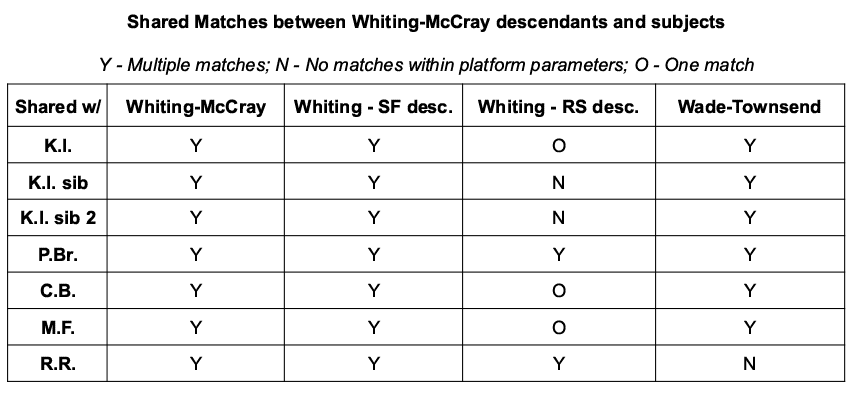
Based on shared matches, only, this is where we were just prior to the launch of Ancestry ProTools2:
I was torn between which of these (the K.I. group, the P.Br. match, etc.) to give focus, so started researching some more on James. We had three, perhaps four, distinct locations and two, possibly three, generations involved. The DNA issues with the A.B. match also indicated that either or both of our extensive documentary genealogy was missing a critical factor so I also reviewed and reopened research on the Whitings.
The Whiting Family History
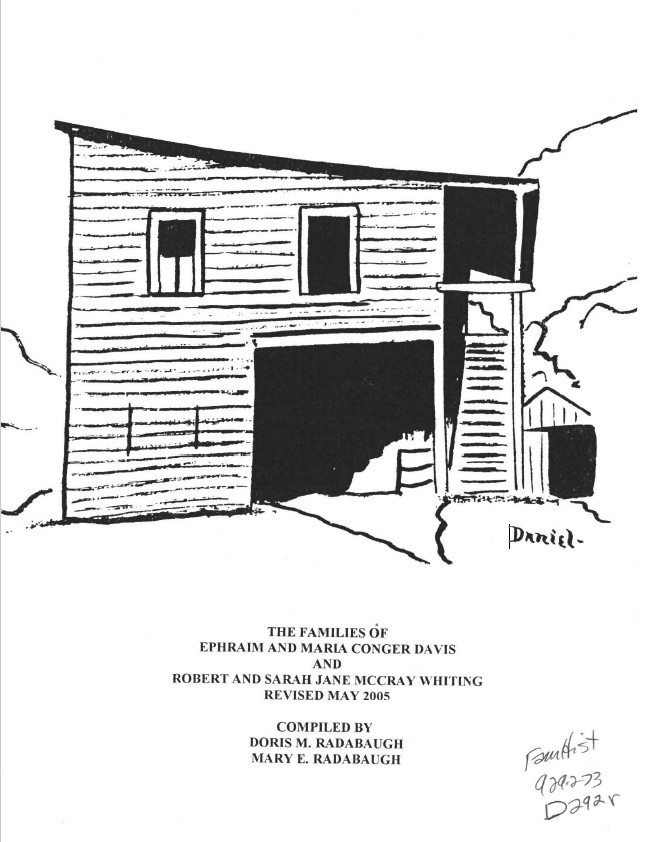
It is fitting, at this point, to again acknowledge the work of my late cousins, Doris and Mary Radabaugh. Doris and Mary had both been educators in the Parkersburg, West Virginia, school system, as well as part-time residents of the farm in DeKalb District, Gilmer County, West Virginia. They had long collected family histories, compiled several books on cemeteries in the Gilmer County area, and published the family narrative and group sheet book, pictured above3. It was, in part, their regular correspondence with family that continued to put the temptation of genealogy before me, over and over, after that initial pique of interest as a youngster.
Doris and Mary traced the descendants of the immigrant couple, Samuel Whiting and Sarah Lancaster, from England into West Virginia, and started the group sheets on the five children who survived to adulthood, including Robert Whiting who married Sarah Jane McCray. They kept these family sheets updated by contacting family regularly, and distributed them in booklet form at the Whiting-Davis reunions they often hosted at the Radabaugh farm on Cedar Creek.
Which Whiting neighbor?
According to our DNA results (above), via shared matches, ICW, and GEDmatch, it is the Whiting-McCray branch where our attention should be directed.
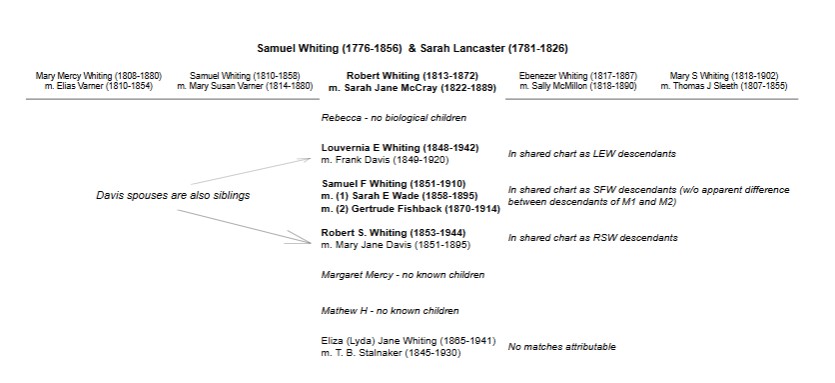
Reviewing the shared DNA and the documented family histories, we can eliminate Rebecca (who had no biological children, see here); Margaret Mercy aka “Maggie,” who died as a young adult without any evidence in documentation or DNA matches as having had children; and, Mathew, who “went west,” and, thus far, no further documentary evidence has been located to confirm his existence beyond the 1902 sale of his personal items in Webster county, nor are any DNA matches alleged or attributed to him.
Louvernia had several children who share matches with the SFW descendants, and K.I. and family, but none carry the Whiting surname. Her husband and Robert Stuart’s wife were siblings; the tested descendants’ DNA results are consistent with the double-cousin relationship in BanyanDNA analysis.4
Robert Stuart Whiting (EFW’s father) had several children, but few grandchildren, and very few younger generation members share reportable DNA with our tested SFW descendants, but at this time we cannot say they do not share with K.I. and family due to platform share restrictions.
Interestingly, Eliza (Lyda) only had two small matches to our SFW descendant testers, and one was discovered to be through her daughter Ola who was born prior to Lyda’s marriage to Theo. Stalnaker, so we are unable to eliminate any other relationships due to the unknown paternity, there. Some of the SFW descendants also have a Stalnaker connection, so these matches could be unrelated to the Whiting side.
Of SFW‘s children, most testers, at this date, were one to two generations removed from our sibling testing pool. The results available supported the documented relationships between the known SFW descendants and their expected placement on the family tree, but the presence or absence of a matched relationship to K.I. and their family (as known, at that point) could not be established with any degree of certainty.
And, thus stood our research and analysis prior to release of Ancestry’s Pro Tools: (1) a definitive Whiting-McCray descendant match to K.I. and their family; (2) findings leading to a Whiting-Wade match to C.B. and M.F. who, due to adoption, cannot be assigned more closely; and, (3) a significant discrepancy in the match amount between the SFW descendant siblings and A.B. and their family, given the documented relationship.5
Navigation
Footnotes
- Norfolk, Virginia, City Directory, 1938. Ancestry.com. U.S., City Directories, 1822-1995 [database on-line]. Lehi, UT, USA: Ancestry.com Operations, Inc., 2011. https://www.ancestry.com/imageviewer/collections/2469/images/10941619?pId=566278399 : accessed 23 Mar 2026. ↩︎
- Table formulated with data from Ancestry (https://ancestry.com), match lists for SFW descendants including the author and her full siblings who tested at Ancestry, uploads and original tests of author and her full siblings at FamilyTreeDNA, and uploads to MyHeritage and GEDmatch, K.I. and family tests at Ancestry, FamilyTreeDNA, MyHeritage, 23andMe (with author), and uploads to GEDmatch. ↩︎
- Radabaugh, Doris M & Mary E. Radabaugh, compilers, The Families of Ephraim and Maria Conger Davis and Robert and Sarah Jane McCray Whiting. Parkersburg, West Virginia, D.M. Radabaugh, 2005. ↩︎
- https://www.banyandna.com/docs/calculations ↩︎
- For statistical averages and standard deviations of shared atDNA at specific relationship levels, see Blaine T. Bettinger, “The Shared cM Project, Version 4.0 (March 2020),” at dnapainter.com : last accessed 20 January 2026. ↩︎